
Therapy in Paris: Finding the Right Approach for You
Seeking an English-speaking therapist in Paris? Learn how to navigate French mental health titles, the benefits of psychodynamic therapy for expats, and how to find verified care.
01
March


Arjun Randhawa
Clinical Psychologist
Choosing the right therapy in Paris starts with understanding two things clearly: how the French mental health system categorizes its professionals (the titles are more layered than they first appear), and which therapeutic approach, symptom management versus root-cause healing, actually matches what you are carrying. This guide walks through both, with a focus on what works best for English-speaking residents and expats navigating life in the City of Light.
The Hidden Challenges of Expat Life in Paris

Building a life in Paris comes with a specific psychological weight that often goes unnamed. It is rarely just the language barrier, though that alone is exhausting in ways people rarely anticipate. It is the accumulation of smaller, persistent adjustments: navigating the bureaucracy, rebuilding a social infrastructure from scratch, and managing the quiet ache of being away from a GP, family, or longtime friends who know your history.
Research on "acculturative stress" indicates that relocation is not merely a logistical transition; it is a genuine psychological adaptation process. This process can impact mood, identity, and day-to-day functioning for months, or even years, following a move. None of this means something has gone wrong. It means the adjustment is real, and it deserves thoughtful, nuanced support.
Demystifying Therapy: Understanding the French Landscape
Before choosing a provider, it helps to understand who does what. The French system is highly specific regarding titles, and navigating this can be confusing for those accustomed to different Anglo-Saxon systems.
Decoding the Titles: Psychologue vs. Psychiatre vs. Psychothérapeute
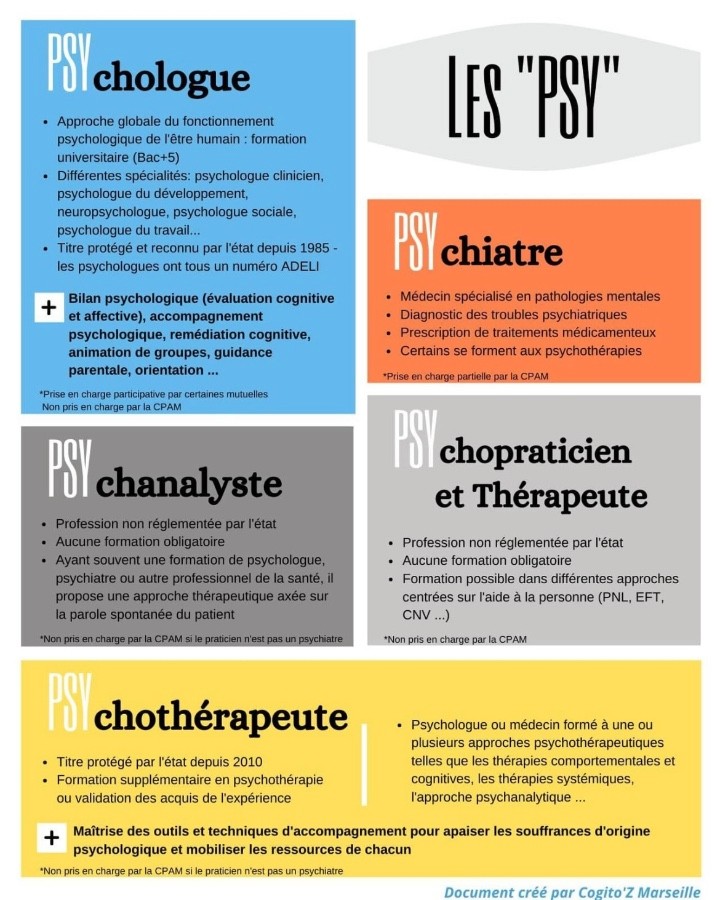
Psychologue: A protected title in France. It requires a minimum five-year university degree in psychology and substantial clinical training. You can verify a psychologue through France's official health directories (such as the ADELI registry).
Psychiatre: A medical doctor who has specialized in psychiatry. They are the only professionals authorized to prescribe psychiatric medication.
Psychothérapeute: As of 2010, this is also a protected title. It requires documented training in clinical psychopathology and registration with the regional health authority (Agence Régionale de Santé).
For English-speaking residents, the difficulty is rarely the quality of French practitioners, but rather linguistic and cultural fluency. Nuanced, emotionally precise therapy requires a bridge of shared cultural reference points that can be difficult to build in a second or third language.
Why Verification Matters: The Its Complicated Standard

Many English-speaking residents in Paris opt for private practice to ensure this fluency. However, verifying the credentials of a private practitioner in a foreign country can feel like a labyrinth.
This is the primary reason I am a verified practitioner on Its Complicated. Rather than asking clients to independently verify a provider's credentials across complex EU regulatory systems, the platform conducts a thorough vetting process, checking degrees, registration, and insurance, before a provider is listed. This removes a significant barrier of doubt, allowing you to focus on the "fit" of the therapy rather than the baseline question of legitimacy.
The "How" Matters: Psychodynamic Approaches to Anxiety
Once you have confirmed a provider’s credentials, the next question is approach. How does this therapist actually work?
Symptom Relief vs. Root-Cause Healing
Anxiety is often treated as a fire to be extinguished. Structured methods, like Cognitive Behavioral Therapy (CBT), excel at this; they offer practical tools to interrupt a spiral or build tolerance for discomfort in the present moment.
Psychodynamic therapy, however, asks a slower, more structural question: What is this anxiety protecting you from, and where did the pattern originate? Rather than treating anxiety purely as a problem to be managed, a psychodynamic approach treats it as a signal, a sophisticated communication from your own history. For anxiety that recurs across different relationships or environments, this root-cause orientation often leads to more durable, structural change.
The Role of Attachment Theory in Your Growth

Adult relational anxiety, especially the kind that flares up during the displacement of an expat move, is often an echo of attachment patterns formed early in life. Attachment theory describes how our earliest relationships shape our expectations of safety, closeness, and independence. Understanding your own attachment blueprint is often the difference between managing temporary symptoms and achieving a lasting shift in how you relate to both yourself and your partners.
How to Prepare for Your First Session
A first session goes more smoothly with minimal pressure. You do not need a polished narrative; your therapist is trained to help shape a scattered starting point into something workable.
Decades of research suggest that the "therapeutic alliance", the quality of the working relationship, is the single strongest predictor of therapeutic success, far outweighing the specific technique used. [Insert link: Placeholder for research on the Therapeutic Alliance/Common Factors Theory]. This means your own sense of being understood in that first session is clinically significant. If it doesn't feel right, that is a valid data point.
Setting Realistic Goals for Your Mental Health Journey
Real, structural change rarely looks like the sudden absence of difficult feelings. More often, it looks like catching a familiar pattern before it spirals, feeling less controlled by a reaction even when the reaction occurs, or noticing a greater capacity to sit with discomfort without immediately needing to escape it.
Tracking Progress: What Change Actually Looks Like
Progress in psychodynamic work is incremental. A useful practice is checking in with yourself every several sessions: Am I relating to my own patterns with more clarity than I was a month ago? That felt shift in perspective is the true indicator of progress.
Are you ready to explore your patterns in a safe, confidential space?
Book your initial consultation here.
About the Author: Arjun Randhawa is a Clinical Psychologist and Psychodynamic Therapist offering private, confidential therapy online for expats and English-speakers in Paris and across France. He specializes in attachment, relationship anxiety, and long-term structural change. He is verified and listed through Its Complicated, EU, which conducts thorough credential checks for all therapists on its platform.
Disclaimer: This article is intended for general educational purposes and is not a substitute for individualized clinical assessment. Please consult with a healthcare professional regarding your specific mental health needs.