
Why Do I Feel Anxious in My Relationship When Everything Is Fine?
Discover how thoughtful, strategic design can directly improve your conversion rates. From building trust to reducing friction, this article explores the key design principles that turn visitors into customers — with practical tips under clear subheadings.
01
March


Arjun Randhawa
Clinical Psychologist
If your relationship is genuinely fine on paper—no major conflict, no red flags—and you still feel a low hum of dread that something is about to go wrong, you are not imagining it and you are not broken. Relationship anxiety symptoms like this are common, and they usually point to an old attachment pattern being activated by present-day closeness, not to an actual problem with your partner or your relationship.
This is one of the most common things I hear in my practice, often from people who are otherwise clear-eyed, successful, and self-aware everywhere except here. So let's slow it down and actually look at what's happening.
Is Relationship Anxiety a Sign of Incompatibility?
Usually not. This is worth saying plainly because the mind under anxiety tends to search for a cause it can act on, and "we're incompatible" feels more solvable than "my nervous system is reacting to old material." But that shortcut is usually wrong.
Relationship anxiety versus incompatibility is a useful distinction to hold onto. Incompatibility tends to show up as specific, repeated disagreements about values, direction, or needs that don't resolve no matter how well you communicate. Relationship anxiety, conversely, tends to show up as a generalized unease that isn't attached to anything specific your partner has actually done. You feel anxious on an ordinary Tuesday. You feel anxious after a good weekend together. The anxiety doesn't track cleanly with events, because it isn't really about the events.
In attachment theory, this kind of anxiety is often understood as a form of what researcher and clinician Sue Johnson calls "protest behavior," a reaction that emerges when someone senses even a small amount of distance from a partner and experiences it as a threat to the bond itself. It's not a sign the relationship is failing; it's a sign your attachment system is working exactly as it was built to, just perhaps a little too sensitively for the situation you're actually in. You can read more about the research behind this in the American Psychological Association's overview of attachment theory.
Gut Instinct vs. Relationship Anxiety

This is the question almost everyone actually wants answered, and it deserves a real answer rather than a reassuring platitude.
How to Distinguish the Two
Relationship anxiety versus gut feeling comes down to a few reliable differences, though none of them are instant or foolproof:
Timing: Gut instinct tends to arrive in response to something specific—a comment, an inconsistency, a boundary being crossed. Anxious projection tends to arrive on a schedule that has nothing to do with your partner's behavior, often peaking during good moments (an "it's going too well" feeling) or during ordinary silence.
Content: A gut feeling usually has a clear, articulable object: "They said X and it didn't add up." Anxious projection is vaguer: a diffuse sense of dread that resists being explained even to yourself.
History: Ask yourself whether this exact feeling shows up in other relationships, romantic or otherwise, and whether it predates this particular partner. If the pattern is familiar, that's a strong signal you're dealing with anxious projection rather than a specific, present-tense instinct.
💡 Clinical Insight: A secondary emotion is one that sits on top of a more vulnerable primary emotion, the way irritability often sits on top of exhaustion. Relationship anxiety frequently works the same way; the anxious spiral is often a secondary reaction covering a primary fear (of abandonment, of not mattering) that hasn't been named yet.
Can Past Trauma Trigger Relationship Anxiety?
Often, yes, and this is where the pattern usually starts to make more sense. Anxious attachment triggers rarely come out of nowhere. They tend to trace back to earlier relationships, frequently in childhood, where closeness was inconsistent, conditional, or unpredictable.
If a caregiver was warm one day and withdrawn or unpredictable the next, a child's nervous system learns to stay alert for the shift. That vigilance was adaptive then. The difficulty is that the nervous system doesn't automatically update the alert once the environment changes. It carries the old pattern forward into adult relationships, including ones that are actually safe.
This is a core idea in psychodynamic work: we don't repeat old relational patterns because they were pleasant; we repeat them because some part of us is still trying to work through, and eventually master, something that felt unresolved. A partner's ordinary tiredness can unconsciously stand in for an earlier experience of someone pulling away, and the old fear gets triggered in a present-day relationship that has nothing to do with the original wound.
Recognizing the Signs
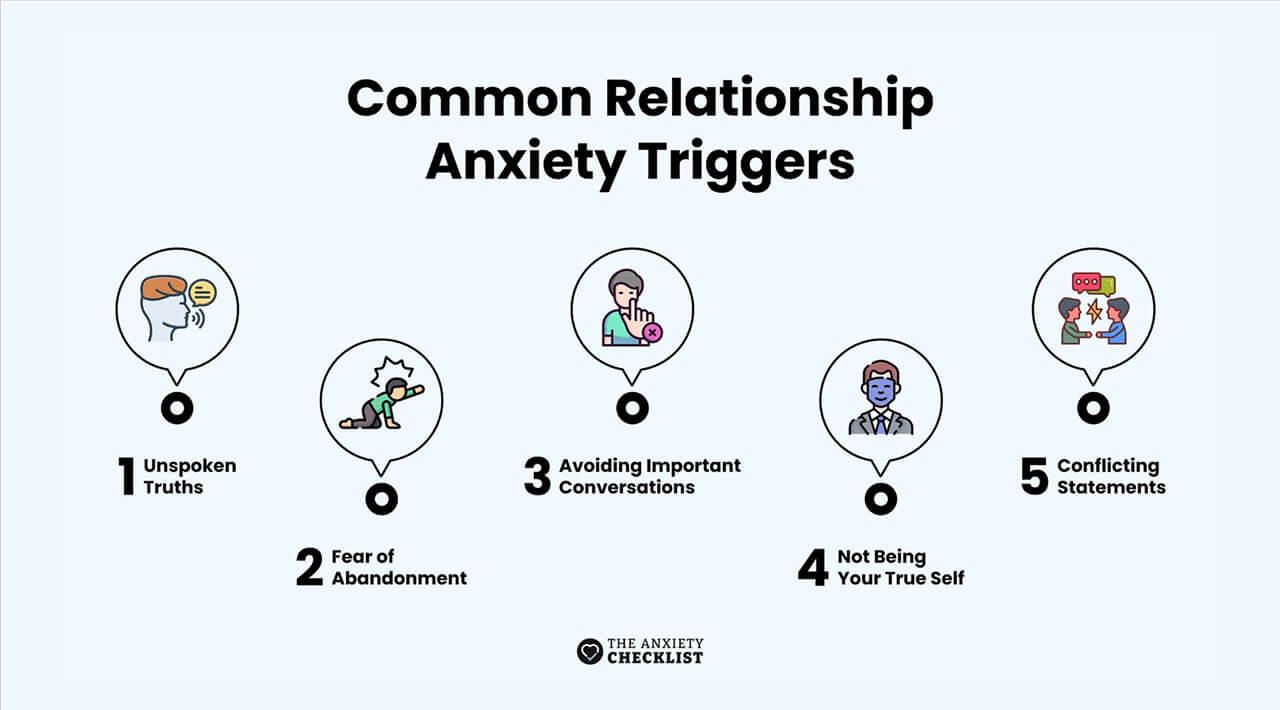
Relationship anxiety rarely stays purely mental. It shows up in the body, often before you've consciously registered the thought behind it.
What are the Physical Symptoms?
Your nervous system, not your judgment, does the talking here. The body reacts to a perceived threat to the bond faster than the conscious mind can evaluate whether the threat is real:
A tight or heavy feeling in the chest, sometimes reading as dread rather than excitement.
A restless, wired feeling, particularly before seeing your partner or checking a message.
Difficulty settling into sleep after a mildly ambiguous interaction.
A stomach that tightens around specific moments, like unanswered texts or a slightly flatter tone than usual.
A low background tension that eases briefly with reassurance, then quietly returns.
Strategies for Healing
You likely won't eliminate the capacity for this kind of anxiety entirely, and that's not really the goal. The more realistic aim is to build enough awareness that the pattern stops running the relationship from the background.
How to Stop Relationship Anxiety
A few starting points that tend to help:
Name it out loud: Even just to yourself, say: "This might be an old pattern, not new information." That sentence creates a gap between the feeling and your response.
Track the timing: Notice whether the anxiety correlates with your partner's actual behavior or with something else entirely, like stress, exhaustion, or an anniversary of an old loss.
Bring it to your partner directly: Frame it as your own experience rather than an accusation. "I'm feeling anxious and I don't think it's about anything you've done" lands very differently than "why are you being distant."
Work with a therapist who understands attachment: Because these patterns typically originate outside conscious memory, insight-oriented work, particularly psychodynamic therapy, tends to be more effective at actually shifting the pattern than management techniques alone.
If this has been a long-standing pattern across more than one relationship, that's a meaningful signal worth bringing into therapy specifically, rather than something to keep managing alone indefinitely. If you’d like to explore where your own pattern originated, reach out to Arjun Randhawa's practice to schedule a session.
A Final Note
Feeling anxious in a relationship that is otherwise going well doesn't mean you're sabotaging something good, and it doesn't mean the relationship is secretly failing. It usually means an old, once-necessary alarm system is still active in a context that no longer requires it. That's not a character flaw. It's a pattern, and patterns can be understood and gradually rewritten with the right support.
About : Arjun Randhawa is a Clinical Psychologist and Psychodynamic Therapist specializing in attachment patterns, relationship anxiety, and the long-term relational effects of early experience. He works with individuals and couples both locally and internationally.
Source
This article was reviewed for clinical accuracy against current attachment theory and psychodynamic literature. It is intended for general educational purposes and is not a substitute for individualized clinical assessment.